I am never riding the Metro again.
After playing the creepy and extremely atmospheric game Metro 2033, I don’t think I can ever step foot into a Metro station again without getting flashbacks to this excellent survival horror first-person shooter. Set in the aftermath of a nuclear war, the remaining Russian population has retreated underground to the Moscow Metro system where the majority of the game takes place. The individual Metro stations have been turned into refugee camps of sorts, with families trying to survive on whatever they can. Many of the camps are run by different factions, some of which are friendly, while others are not. Travel between these crowded stations is possible but dangerous due to the mutants, bandits, and anomalies that have taken up residence in the sprawling Metro tunnels. The setting is extremely dirty, depressing and claustrophobic, but rendered in amazing detail. Every inch of the Metro system seems plausible, and years of neglect have never looked so awesome. With resources so scarce, life seems to be hanging on by a thread. The world is clearly dying, with everything, including the tunnels which preserve this last bit of humanity, rapidly deteriorating. Still, there is still a lot of life left in the people in these Metro stations, and they are not willing to disappear without a fight.

You play the game as Artyom, the son of the leader of one of the Metro stations. The Mutants have become more aggressive recently, attacking the station in greater numbers. The only hope of survival for those in the station are for you to get a message to one of the other, stronger Metro stations, asking them for help. However getting there, though the dangerous subway system, past the mutants, anomalies, bandits, and more will be no easy task. Luckily you are not alone in this, and you will have a number of companions to help you with your journey.
The game takes a lot of gameplay cues from existing survival horror games. This means limited supplies, dark corridors, oppressive atmosphere, and scary enemies. Friendly Metro stations, which can be thought of as hubs between missions, provide opportunities to catch your breath and trade for supplies. The currency in the tunnels takes the form of pre-war ammunition. Considering how hostile the world is, it’s not very surprising that bullets are more valuable then money. Pre-war ammo is becoming more and more scarce, so Metro residents have begun creating their own “dirty” rounds. These homemade rounds are not as powerful as the pre-war munitions, however they are plentiful. Balancing between firing dirty rounds and pre-war ammo, which doubles as your currency, creates an interesting gameplay choice. Do you want to take down the enemies quicker using less ammo, or save the ammo to buy more powerful weapons but stick to using the less effective rounds?

The gunplay in the game is pretty solid for the most part. There is an interesting selection of weapons that range from pre-war guns like AK-47s to weaponry made down in the Metro. These Metro weapons are often pneumatic in nature, requiring you to manually pump air into them (think squirt guns) before they can fire their ball bearing rounds. They take longer to prep, but they are silent and rather powerful. The guns behave in a realistic manner, and there are a number of choices for upgrades that range from scopes to silencers. The mutants behave as one would expect, charging after you without much intelligence. The human opponents show a reasonable amount of intelligence, and provide a challenge.
If brute force isn’t your thing, stealth is a viable option in the game. The Metro tunnels are naturally dark, and light sources can be eliminated to provide even more cover. There are a number of silent weapons, such as the pneumatic weapons discussed earlier, as well as throwing knives the like. The enemies react to noises as you would expect, investigating sounds and alerting other guards upon discovering you. Stealth is never outright required, but at times it certainly pays off to take the quiet approach.

If there is one defining aspect of this game it is that it absolutely nails the sense of atmosphere and immersion. It goes beyond the exquisitely detailed environments and superb graphics though. In a manner similar to that of Far Cry 2, a lot of the game’s HUD has been replaced by in-game items and other in-game visual feedback. For example, throughout the game you have to make use of gas masks. These masks occasionally require filter changes, but there is no timer on the HUD that tells you when to swap them. Instead, you can look at the watch on the character’s wrist. Other in-game feedback that indicates it’s time to swap filters is when your character’s breathing becomes heavy and the mask begins to fog up. Likewise, mission objectives are written on a journal that you can pull up and read without being pulled out of the experience. Other neat little touches includes a hand crank that you use to charge up battery powered items such as night vision goggles and flashlights. Instead of having a meter that displays battery power, your flashlight becomes visibly weaker over time. Taking out your hand and giving it a few pumps brings your flashlight back to life. Individually these little touches are not a big deal, but when taken together they help to really bring this world to life and immerse you in it.
If there is one real disappointment about the game it has to be its ending. This is a spoiler free review, so I won’t go into too much depth about what happens. However I think it’s safe to say that the very end of the game consists of a sequence of trial and error events. During this sequence I felt like a mouse in a maze that has to memorize the correct set of turns to get out. It was somewhat disappointing given the buildup, but I still found the overall ending of the game sufficient.
Overall, Metro 2033 is an excellent ride. Be sure to buy a ticket.

Tonight is the night that Microsoft is pulling the plug on the Xbox Live servers for original Xbox games. They want to make enhancements to the service, and apparently supporting the old games is holding them back. They have not mentioned any specifics as to what type of enhancements are being blocked by supporting legacy Xbox games, but some have suggested that the 100 friend limit is a result of keeping backwards compatibility. Honestly, I am surprised they have kept it running this long. Eight years is a pretty long time, especially considering how long the 360 has been around.
Anyway, a bunch of people are playing Halo 2 tonight, and I figured I might as well join them. If you have a copy of Halo 2 laying around, consider jumping on and playing a few rounds. Also, make sure to download the map packs while you still can. Once Live goes down, I don’t expect you to be able to download them ever again.
Also, Halo 2 for PC is sill alive and well and you can still find me playing it from time to time. If you want to keep the Halo 2 action going, pick up a copy and join me:

I have decided to start posting about music more then I have been, since I have gotten some messages from people telling me they are enjoying some of the music I have posted from artists they have never heard of. This year is going to be awesome for me. Two of my favorite musicians have already released new albums (These Hopeful Machines, Disappear Here), and some more are on the way from other bands that I really like as well.
One of these upcoming albums is Immersion from Pendulum. The album is set to be released this May. They have already started to release some material about it, including the first single and a music video to go along with it. What I have heard sounds great, and I will certainly be ordering this the day its released.
You can listen to their first single, Watercolour, below. You can follow Pendulum from their website.
Pendulum is an Australian drum and bass/rock group originally from Perth, Australia formed between producers Rob Swire, Gareth McGrillen and Paul Harding. They have gained major popularity in the UK, and have started making a name for themselves overseas. After a shift in musical style incorporating a rock-oriented sound and more electronic influences other than drum and bass, ranging from dubstep to house music, Pendulum is now better known for their energetic live shows, with live band setup and advanced visual displays.

First I get BT’s These Hopeful Machines and now I get a new Hybrid album? This is becoming an awesome year for music.
Since first bursting onto the scene with the now classic album Wide Angle in 1999, the Swansea, Wales-based Hybrid have been known as one of the most forward thinking and technically skilled acts in electronic dance music. Blurring the line between in-studio production and live presentation, Hybrid are one of the few remaining dance acts to perform live with a classic band setup.
Though, much has changed on the road to Hybrid’s fourth artist album Disappear Here. Most notable is the addition of Hybrid’s third member – singer/ songwriter Charlotte James – to go along with founders Chris Healings and Mike Truman.
Charlotte’s impact is marked as Disappear Here is truly an album of real songs and not merely dance beats with vocals on top. It offers a lot more than anything Hybrid has ever previously written and pushes boundaries in every way.
With Disappear Here, Hybrid have managed to create an epic and unique sound which has progressed dramatically from its original dance inception but still retains much of what makes electronic music so exciting. The album features guest vocals from Tim Hutton, drums from Alex Madge and the City of Prague Philharmonic Orchestra.
You can buy the cd here (comes with a digital copy so you can start listening now) or buy only the digital album here.

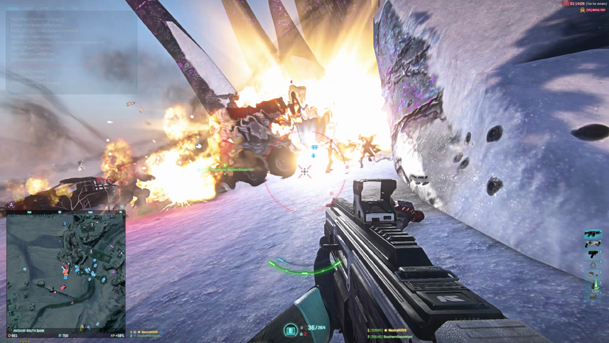
Tribal Wars is a team based multiplayer shooter modification that utilizes some of the team oriented aspects of its parent title, Enemy Territory: Quake Wars, and combines it with equipment and weaponry found in titles such as Starseige: Tribes and Unreal Tournament. The game takes place in era far after Quake 4 where humanity has just recovered from a longstanding war against a formidable foe, but now find each other in conflict with one another; all vying for supremacy.
Download:
Tribal Wars (381.94 MB)
Tribal Wars v1.1 Patch (8.14 MB) – Read Patch Notes and install instructions here
PACKAGED VERSION INSTRUCTIONS
This package is WINDOWS ONLY. Ensure you have the v1.5 Patch for ETQW.
Download the installation package. The installer will ask for the Installation Directory, select the Enemy Territory – Quake Wars folder. Wait until the extraction process is complete. You will now have a Desktop icon which you can use to run the game.
If you have the Steam version of the game the Desktop icon will not work, you may remove it. You will have to add a Steam Launch item by pressing the “Add non-Steam game…” button. Locate etqw.exe in your ETQW installation folder and add it to your list. Select the list item and go to properties, and add these launch parameters:
+set fs_game twars
You can now use this launch item to start the game.
To find servers: In the server browser, go to the filters list. At the bottom is a twars filter and you should turn it on.
Visit the Tribal Wars website at http://twars.org.